
Top South Decks & Porches has outlined how repeated swings between dry and wet ground conditions affect residential deck materials, following a year in which northern Georgia has moved through both extremes. The Johns Creek contractor said the pattern has practical consequences for material selection that homeowners rarely weigh when planning a project.
National Weather Service drought information statements for north and central Georgia recorded severe drought expanding across the region in January, with drought conditions persisting through February. Weeks of sustained rainfall through the spring reversed much of that, and improvement was most pronounced across north Georgia. By late July, the United States Drought Monitor again showed active drought across roughly a fifth of the state, with a further 60 percent classified as abnormally dry.
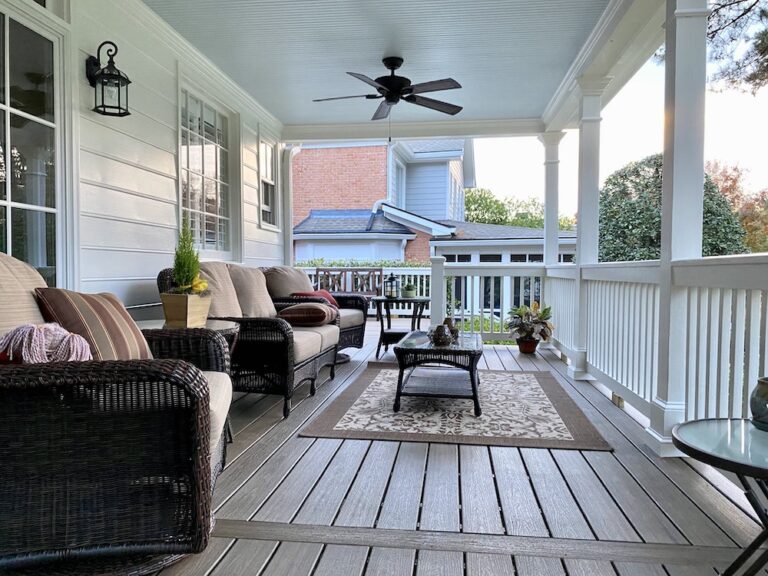
That sequence matters because moisture stress on exterior building materials is cumulative rather than singular. Extended dry periods draw moisture out of exposed surfaces and the ground beneath them. Heavy rainfall then returns over a period of hours. Each transition moves materials through a dimensional change, and the effect compounds across repetitions rather than resetting between them.
"Most people ask which board lasts longest, and the more useful question is what the board is going to be asked to do here," said Federico De Aramburu, Owner of Top South Decks & Porches. "A year like this one puts materials through the full range twice over."
Decking products intended for exterior use are evaluated against a published standard rather than manufacturer description alone. ASTM D7032 governs the establishment of performance ratings for wood-plastic composite and plastic lumber deck boards, guards and handrails, and ICC Evaluation Service acceptance criteria AC174 sets out how those products are assessed for code recognition. Completion of the applicable testing forms the basis for code recognition of these products in exterior applications.
The testing regime addresses weather exposure directly. Material testing under the standard includes ultraviolet resistance, conducted in equipment complying with ASTM G155, and hygrothermal cycling in which specimens are submerged, frozen, returned to laboratory conditions and retested across repeated cycles. Flexural strength and flexural stiffness are then compared against unexposed control specimens to derive adjustment factors for the product.
That structure explains why a general comparison between material categories is less useful than it appears. Composite boards combine wood fiber with polymers, and PVC boards contain no wood content, which is a genuine compositional difference. The performance figures that follow from it are established product by product through testing rather than by category, and each evaluation report states span ratings and capacities for the specific formulation assessed.
Top South Decks & Porches works in composite, PVC and pressure-treated materials and selects between them according to exposure conditions on each section of a project. Evaluation reports carry revision and renewal dates, and the company noted that current documentation should be confirmed rather than assumed at the point of specification.
Ground conditions form the second half of the question. Soils of the Cecil series, the most extensive series mapped across the southeastern Piedmont, are described by the United States Department of Agriculture Natural Resources Conservation Service as very deep and well drained, with medium surface runoff and moderately high saturated hydraulic conductivity. The series carries a low shrink-swell rating and occurs on slopes ranging from zero to 25 percent.
That description differs from the assumption frequently applied to Georgia red clay in general discussion. The practical planning issue on these soils is the route surface runoff takes across a sloped lot and the erosion potential that follows, rather than ground volume change beneath a structure.
Foundation selection proceeds from those site conditions. Top South Decks & Porches builds on helical piers and on traditional concrete footings, with the choice guided by soil, slope, and the size and loading of the structure. Parcel-level soil data is publicly available through the Natural Resources Conservation Service Web Soil Survey, which reports the mapped series for an individual property.
Framing and connections respond to the same conditions as the surface above them. Dimensional movement in wood framing acts on fastener connections and hanger engagement over time, which is one reason inspection of a deck substructure is treated separately from assessment of its walking surface.
"The decking gets all the attention because that is the part people see," De Aramburu said. "The frame and the footings are doing the work that determines how the deck feels in ten years."
Top South Decks & Porches is a family-owned deck, porch and outdoor living contractor founded in 2016 and based in Johns Creek, Georgia. The company handles projects from design and permitting through construction and final inspection using in-house crews.
###
For more information about Top South D&P, contact the company here:
Top South D&P
manuela pelaez
+16786583384
mpelae11@gmail.com
6470 East Johns Crossing, Suite 160, Johns Creek, GA 30097, United States