
LVMC Decks has released guidance for property owners on how residue from the spotted lanternfly affects decks, patios and other outdoor surfaces, timed to the period when adult populations of the invasive insect are most active across Pennsylvania.
The Pennsylvania Department of Agriculture reports that honeydew produced by the insect can coat decks and play equipment, and that residents in affected counties describe the insect interfering with their ability to enjoy outdoor areas. Penn State Extension documents that the sooty mold which grows on that honeydew frequently stains tree trunks, decks, patios and vehicles positioned beneath affected trees, and that those stains can be very difficult to remove.
Adult spotted lanternflies are present from July through December, with late-stage nymphs appearing from July through September. The insect was first identified in Berks County in 2014 and now has established populations in 26 Pennsylvania counties, including those where the company operates.
"The staining is what people notice, and by then the cause is usually overhead rather than on the deck itself," said Norm Boell, co-founder of LVMC Decks. "It comes up often enough now that it belongs in the conversation about where a structure goes, not just what it gets built from."
Honeydew falls from feeding insects onto whatever sits below, and the sooty mold that grows on it produces the discoloration property owners eventually see. Because the residue accumulates dust and pollen as it dries, it can be mistaken for general weathering rather than an identifiable and seasonal source.
That relationship makes the position of a structure relative to nearby trees a design question. A deck or patio sited directly beneath a canopy will accumulate more residue than one placed a short distance clear of it, and that difference is settled once, during planning.
Penn State economists have estimated that an uncontained infestation could cost Pennsylvania at least 324 million dollars annually, a figure that reflects agricultural and forestry impact alongside the nuisance effects reported by residents. The scale of that estimate is part of why the insect has remained a subject of active public guidance across the state.
Penn State Extension notes that removing certain host trees can prevent honeydew and sooty mold from accumulating on property beneath them, which is work for an arborist or landscape professional rather than a deck contractor. What falls within the scope of a builder is where the structure sits and how easily its surface can be cleaned.
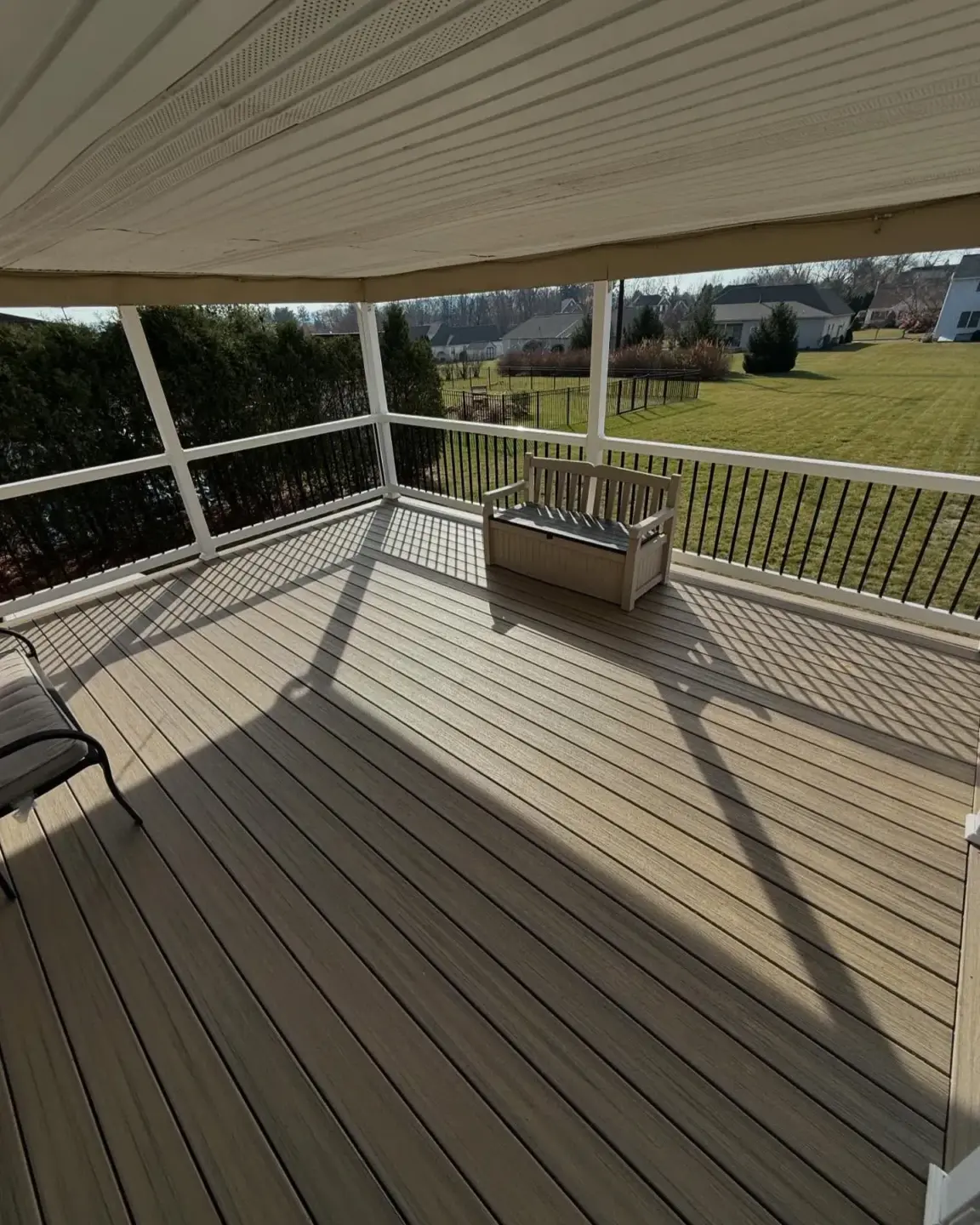
The company installs decking in wood, hardwood, composite and PVC. Surface material affects how routine cleaning is handled, though no material removes the need to account for surrounding vegetation, overhead cover and drainage when a structure is planned.
Overhead cover factors into the decision in more than one direction. A covered porch, a solid roof cover or a pergola changes what reaches the surface below it, and those structures are frequently considered alongside the deck rather than added afterward.
Site conditions vary meaningfully across the region the company serves. Ground in Northampton County tends to be rolling and often sloped, while terrain across Monroe County and the wider Pocono region is rockier and more heavily wooded, which means mature tree cover is a more common factor on parcels there.
The space beneath an elevated structure raises a related consideration. Underdeck systems channel water away from the framing above, and how easily that area can be reached affects the routine upkeep of any structure positioned near substantial tree cover.
Those questions are addressed during the company's design phase, which includes three-dimensional modeling and two-dimensional floor plans produced before construction begins. Reviewing overhead cover and structure placement at that stage allows the position to be adjusted while it costs nothing but time.
Current information on spotted lanternfly distribution and activity is published by Penn State Extension and the Pennsylvania Department of Agriculture. Property owners can review the status for their own county through either agency before planning outdoor work.
Norm Boell founded the company with his son Blaize Boell in December 2013. The business operates from Nazareth in Northampton County and East Stroudsburg in Monroe County, serving the Lehigh Valley and the Pocono Mountains.
LVMC Decks is a family owned and operated deck and outdoor living builder. The company designs and builds custom decks, porches, patios, pergolas and outdoor living structures in wood, hardwood, composite and PVC, along with railing, lighting, framing, skirting and underdeck systems.
###
For more information about LVMC Decks, contact the company here:
LVMC Decks - East Stroudsburg
Blaize Boell
+12677628717
info@lvmcdecks.com
138 N New St, Nazareth, PA 18064, United States